Animal origins happened once. There is no replay — only living organisms, molecular traces and competing explanations. These are the ideas that guide how we look for evidence.
Reconstructing the first animals requires more than finding familiar genes. It requires knowing what has been lost, discovering what remains unseen and testing several cellular routes without assuming the answer in advance.
01Taxon sampling
The ancestor depends on who you sample.
An ancestor is not observed directly. It is reconstructed from the organisms that survive around it. For example, if choanoflagellates — or filastereans — are treated as the only window onto the unicellular past, lineage-specific gene losses can be mistaken for ancestral absence.
Animal biology has been studied across tissues, stages, species and centuries. Their closest unicellular relatives remain represented by comparatively few genomes, cultures and experimental systems. We are not comparing two equally known worlds.
UNICELLULAR RELATIVESA world still coming into view
Knowledge asymmetry — not biological importance
03Alternative routes
There may have been more than one route.
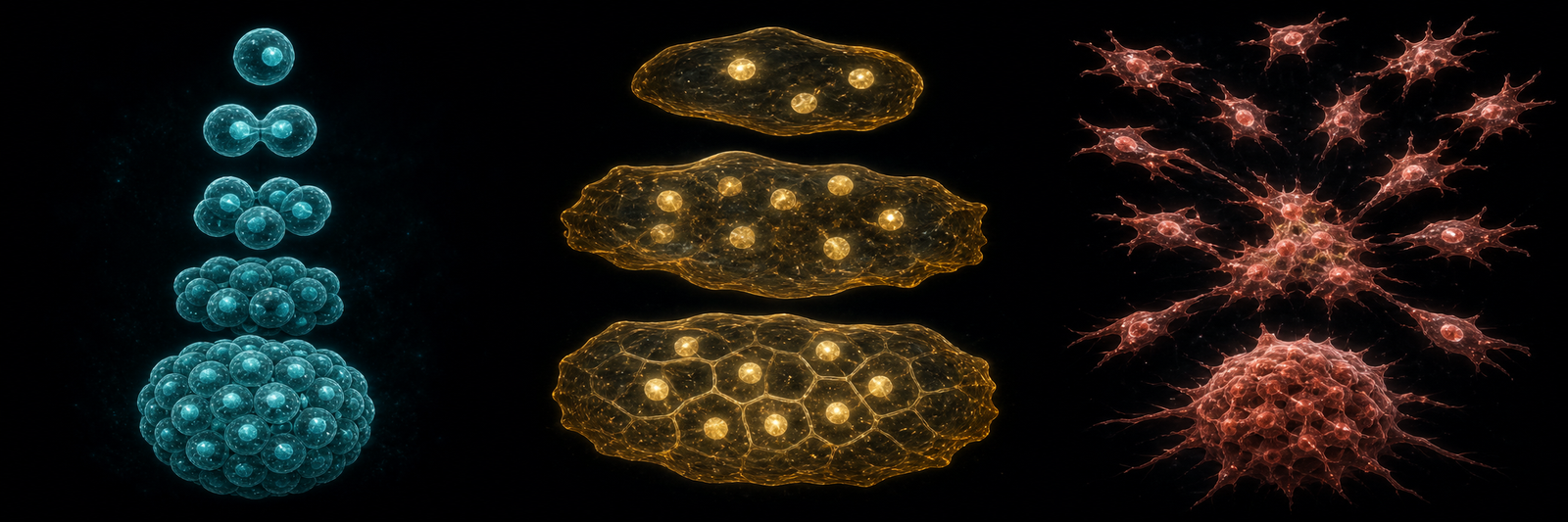
Clonal colonies are one compelling route to animal multicellularity — but not the only plausible one. Aggregative multicellularity and cellularisation from multinucleate cells offer equally serious evolutionary hypotheses that can now be tested experimentally.
02Coenocytic / syncytialNuclei coordinate before cellularisation
03AggregativeIndependent cells come together
Conceptual visualization — not a literal ancestral reconstruction
04The animal operating system
Integration may have mattered more than invention.
Many molecular and cellular technologies predate animals. The decisive transition may have been their integration: ancient modules brought under a shared regulatory system that coordinated cells in space and time and opened an entirely new ecological possibility.
Reviews do more than summarise facts. They reveal how the field has framed the problem — and how those frameworks change as new organisms and experiments appear.
This section will connect our perspectives with alternative models, emerging consensus and questions that remain genuinely open.
OUR PERSPECTIVE · OTHER PERSPECTIVES · EMERGING CONSENSUS · OPEN QUESTIONS