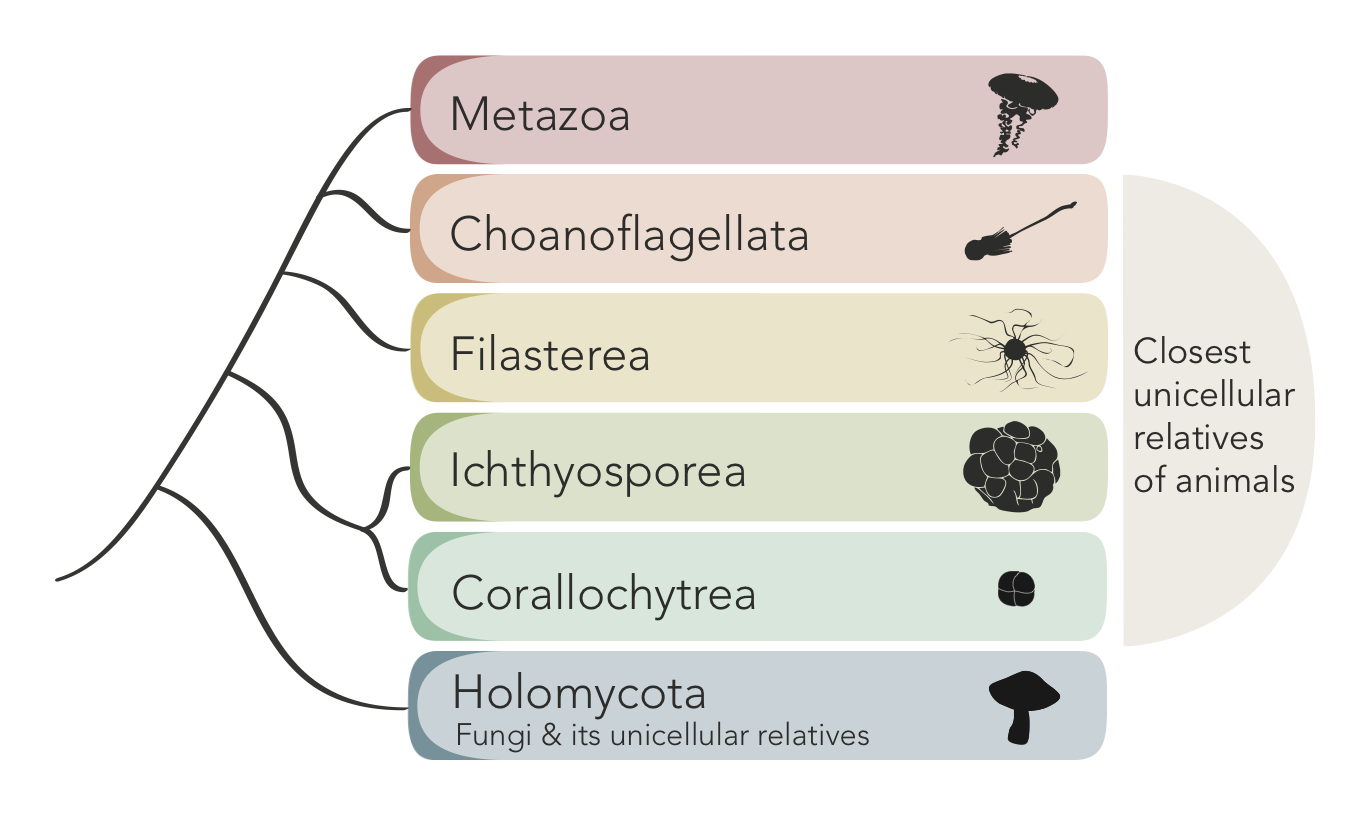
Our laboratory is not built around one species or one technology. We discover, cultivate and compare the organisms that can reveal different parts of the same historical transition: the origin of multicellular animals.
SIX CONNECTED PROGRAMMES
Different scales. One evolutionary problem.
01RECONSTRUCT
What was the unicellular ancestor of animals like?
We use broad taxon sampling and comparative genomics to reconstruct the genetic and cellular potential of the unicellular ancestors of animals. Every additional lineage changes the inference—and reveals what other lineages have lost.
Many genes associated with animal adhesion, signalling, transcription and differentiation originated before animals. We ask how these ancient modules were regulated, connected and integrated into an operating system capable of coordinating multicellular life.
AdhesionSignallingTranscriptionCell cycleCell statesANIMAL OS
03EXPERIMENT
Which cellular route led to animals?
Clonal division is not the only plausible route. Aggregative multicellularity and cellularisation from multinucleate cells offer alternative hypotheses. Our organisms allow these routes to be compared experimentally rather than assumed.
Nuclei divide within one cell; cellularisation follows.
Aggregative
Independent cells gather into a collective.
Clonal
Daughter cells stay together after division.
Alternative hypotheses for animal origins. The ancestral route remains unresolved.
04DISCOVER
How can the unknown change what we think we know?
The unknown is not peripheral to this field—it can transform it. Entire lineages close to animals remain known only through environmental DNA. Finding them can alter our reconstruction of the ancestor, reveal unexpected biology and open questions that cannot yet be imagined.
Environmental diversityIsolationCultivationNew model systems
Cells coordinate growth, differentiation and collective behaviour while energy and nutrients fluctuate. We investigate whether metabolic state and energy availability helped cells make the transition from individual lives to coordinated collectives—and how metabolism continues to shape the balance between individuality and cooperation.
We are investigating whether metabolic state helps shift the balance between cellular individuality and cooperation.
06REVERSIBILITY
Can animal origins help us understand cancer?
Cancer disrupts the cellular cooperation on which multicellular life depends. We are testing whether tumour progression and therapy resistance share cellular behaviours or regulatory responses with aggregation, stress and dormancy in unicellular relatives of animals. We are investigating whether Capsaspora could offer an experimentally tractable system in which to examine these possibilities.
Cancer evolutionCell cooperationDormancyTherapy resistance