Evolutionary position
A filasterean: one of the closest unicellular relatives of animals.
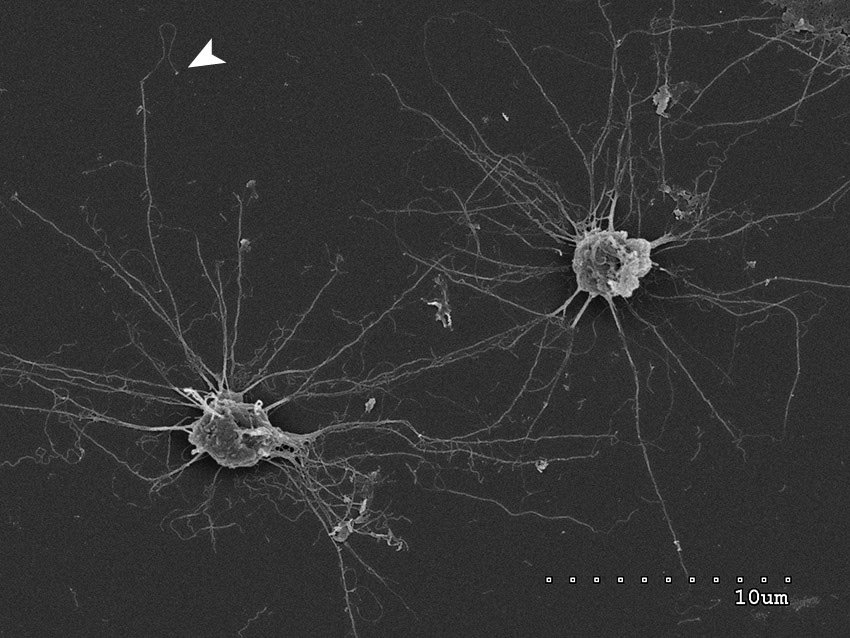
FILASTEREA / MODEL 01
A living model for testing how cell aggregation could have contributed to animal origins.
Scanning electron microscopy · Multicellgenome Lab
ONE ORGANISM
Capsaspora moves reversibly between three distinct cellular states. Together, they reveal how a unicellular relative of animals can change shape, behaviour and social organisation.
THE LIFE CYCLE
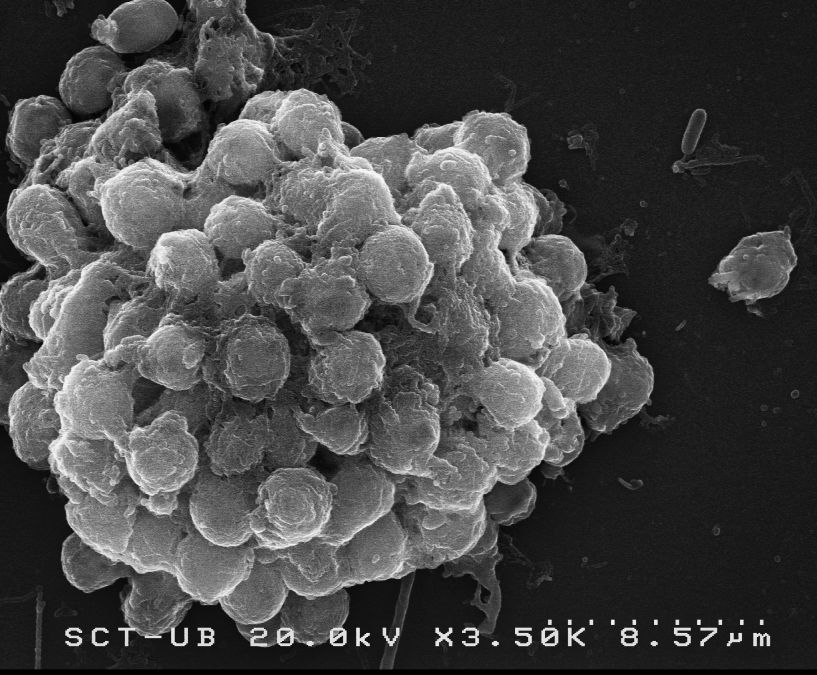
02 / Aggregative
Individual cells assemble into reversible multicellular aggregates, connected through an intricate network of filopodia.
THE EVOLUTIONARY QUESTION
Capsaspora does not answer this question by itself. It gives us something just as important: a living experimental system in which to test how cells recognise one another, come together and coordinate multicellular behaviour.
WHY CAPSASPORA?
A filasterean: one of the closest unicellular relatives of animals.
Cells enter and leave an aggregative state, allowing the transition to be observed experimentally.
Its genome contains genes once considered unique to animals — including T-box, Runx and NF-κB transcription factors, the integrin adhesion machinery and tyrosine kinases.
THE EXPERIMENTAL SYSTEM
Over two decades, Capsaspora has become a platform for connecting cell behaviour with genomes, signalling and evolution.
GENOME & DATA
KEY DISCOVERIES
Phylogenetic evidence established Capsaspora as an independent opisthokont lineage close to animals.
↗2013Its genome revealed a rich ancestral genetic toolkit for animal multicellularity.
↗2013The aggregative stage is governed by a dynamic phosphosignalling programme.
↗2016Epigenomic and functional-genomic maps revealed how regulatory programmes change across the life cycle.
↗2016Proteomics uncovered extensive remodelling of proteins and phosphosignalling between cell states.
↗2018A transfection method turned Capsaspora into a tractable experimental system.
↗2020Cell-cycle transcriptomics revealed 801 periodically expressed genes and a cyclin–CDK system with an ancestral temporal architecture.
↗2022An independent team extended the Capsaspora toolkit, using homologous recombination for targeted genome modification.
↗2023Calcium and lipoproteins regulate multicellular aggregation in Capsaspora.
↗2025 · PREPRINTExperiments, transcriptomics and mathematical modelling establish Capsaspora as a predictive system for studying aggregative multicellularity.
↗2026Bayesian learning strategies reveal how single-cell life can integrate environmental information.
↗CONTINUE EXPLORING