Binary fission
Most cells divide into two daughters. Yet nuclear division and cytokinesis do not happen at the same time.
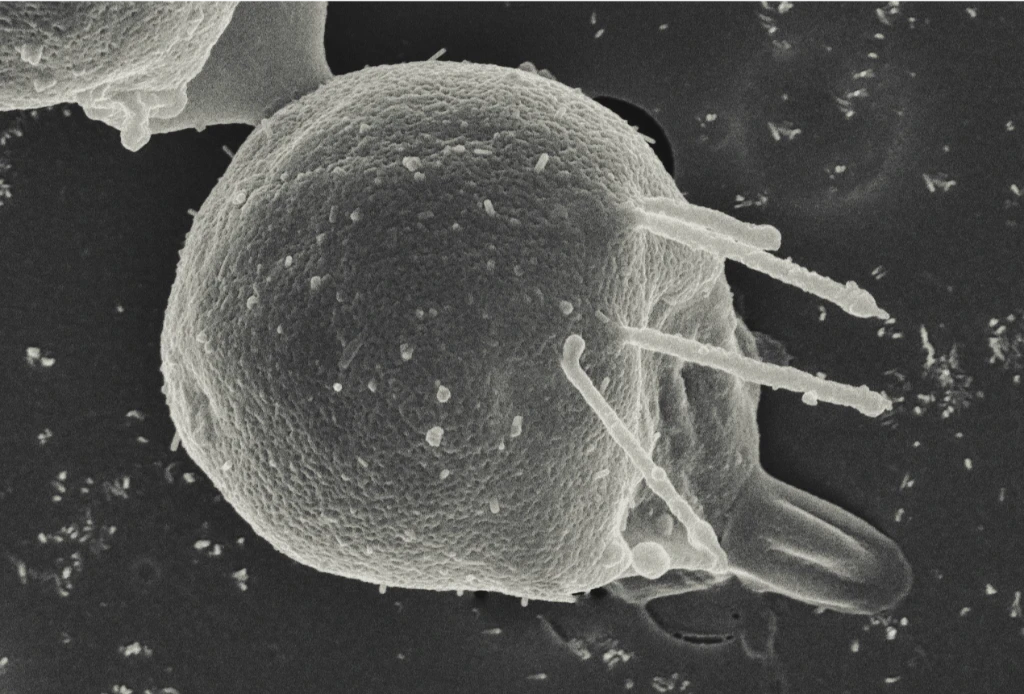
CORALLOCHYTREA / MAIN EXPERIMENTAL SYSTEM
One cultured species.
An entire holozoan lineage.
Scanning electron microscopy · Multicellgenome Lab
CELL DIVISION, RECONSIDERED
As the only cultured representative of Corallochytrea, Corallochytrium limacisporum gives us experimental access to an entire distinct lineage among the closest unicellular relatives of animals. It can divide by binary fission—or postpone cytokinesis and enter a multinucleate state.
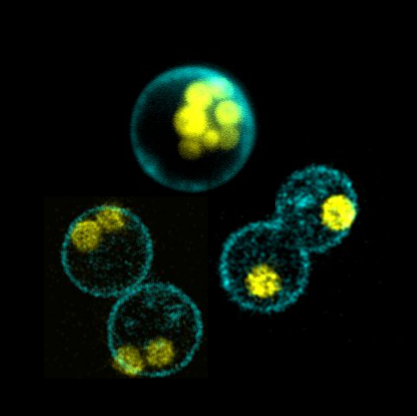
A NON-LINEAR LIFE CYCLE
Most cells follow binary fission. A minority instead continues nuclear division, producing coenocytes with several nuclei. The two developmental routes coexist in the same species.
Cell boundaries in cyan · nuclei in yellowTHE DIVISION REPERTOIRE
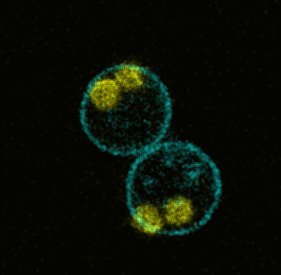
Most cells divide into two daughters. Yet nuclear division and cytokinesis do not happen at the same time.
Cells spend much of their cycle with two nuclei: one cell, temporally suspended between nuclear and cellular division.
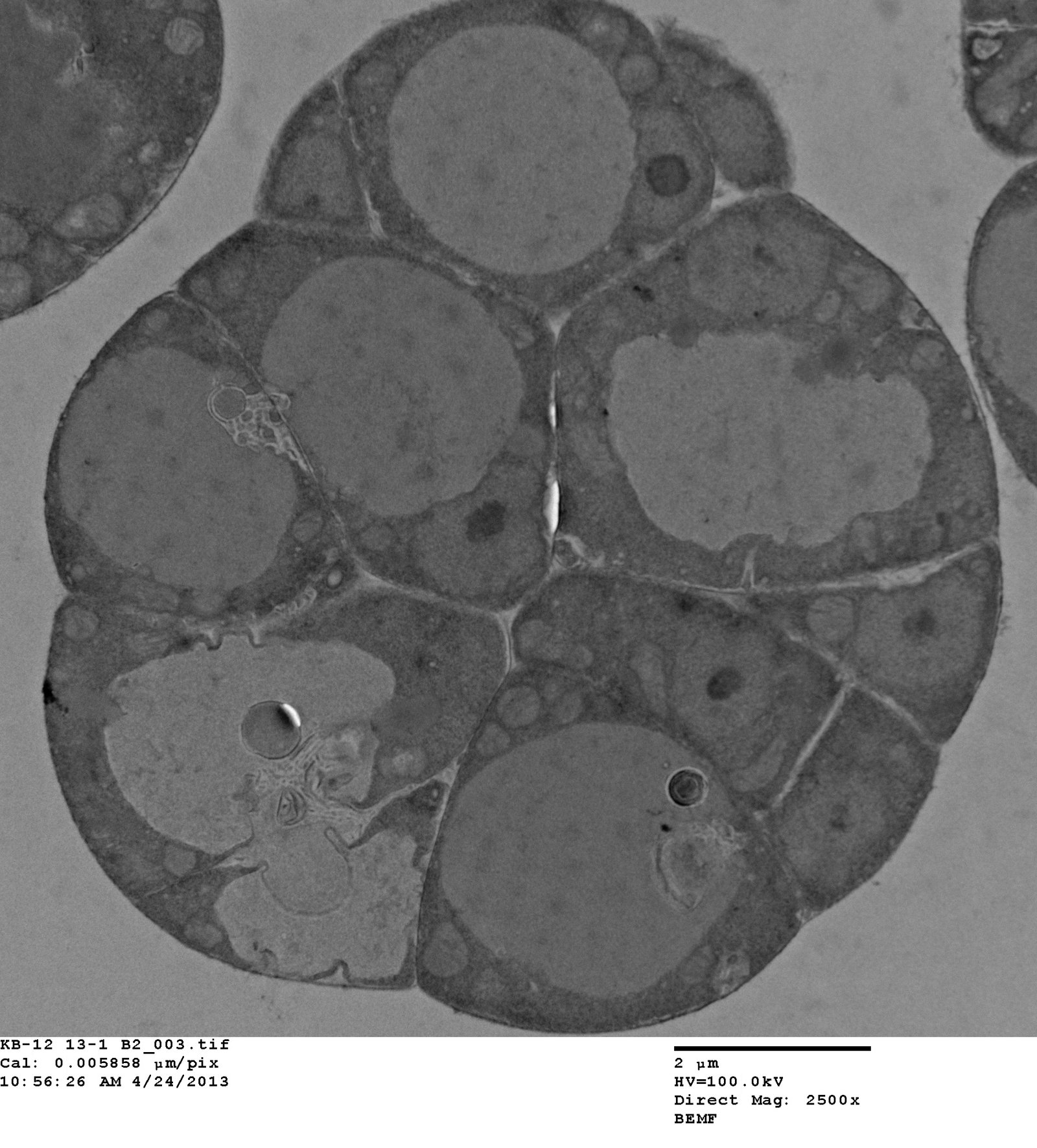
A small fraction continues nuclear division without cytokinesis, producing several nuclei inside one cytoplasm.
WHY IT MATTERS
Corallochytrium belongs to one of the earliest-branching lineages among the unicellular relatives of animals. Its unusual coupling—and uncoupling—of mitosis and cytokinesis lets us test how ancient cells controlled nuclear number, cell boundaries and developmental transitions.
FROM ORGANISM TO MODEL
A tractable marine protist maintained through a reproducible life cycle.
Cell boundaries, nuclei and division paths can be followed through time.
Fluorescent reporters made its hidden cell biology experimentally visible.
Gene inactivation and precise point mutations now make causal tests possible.
FOUNDATIONAL WORK
Taxon-rich phylogenomics recovered Corallochytrium as the sister lineage to Ichthyosporea, together forming Teretosporea.
↗2017Its genome helped reconstruct how the molecular toolkit changed along the animal stem lineage.
↗2021Stable transfection exposed binary fission, coenocytic growth and the temporal separation of mitosis from cytokinesis.
↗2025Gene inactivation, point mutation and co-editing established Corallochytrium as a genetically tractable, haploid model.
↗GENOME & RESOURCES
CONTINUE EXPLORING