Amoeba
A motile cell disperses, explores its environment and begins a new developmental cycle.
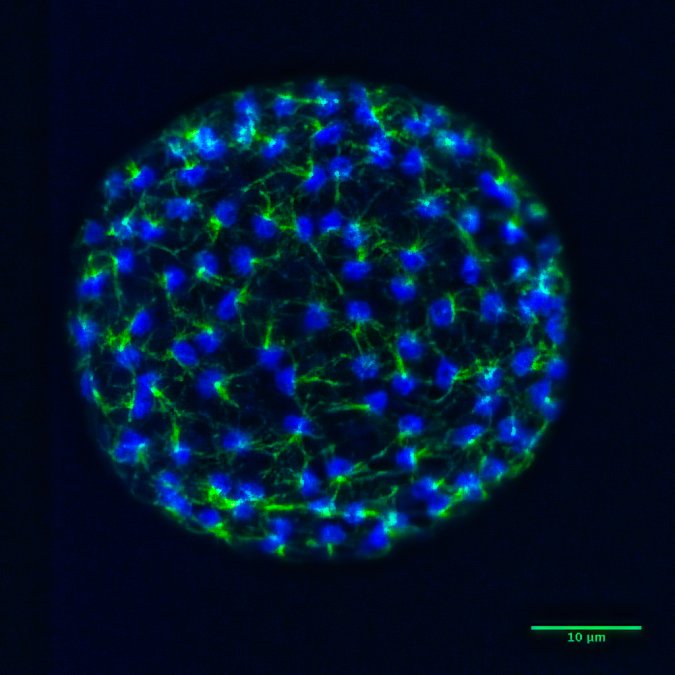
ICHTHYOSPOREA / MAIN EXPERIMENTAL SYSTEM
One cell.
A generation forming within.
Actin in green · nuclei in blue · Multicellgenome Lab
MULTICELLULAR DEVELOPMENT
Creolimax fragrantissima begins as a motile amoeba. It settles, grows and repeatedly divides its nuclei inside one expanding cell. Then, in a coordinated transformation, it builds many daughter cells and releases a new generation.
DEVELOPMENT IN MOTION
THE LIFE CYCLE
A motile cell disperses, explores its environment and begins a new developmental cycle.
The cell settles and expands while repeated, synchronized nuclear divisions build a coenocyte.
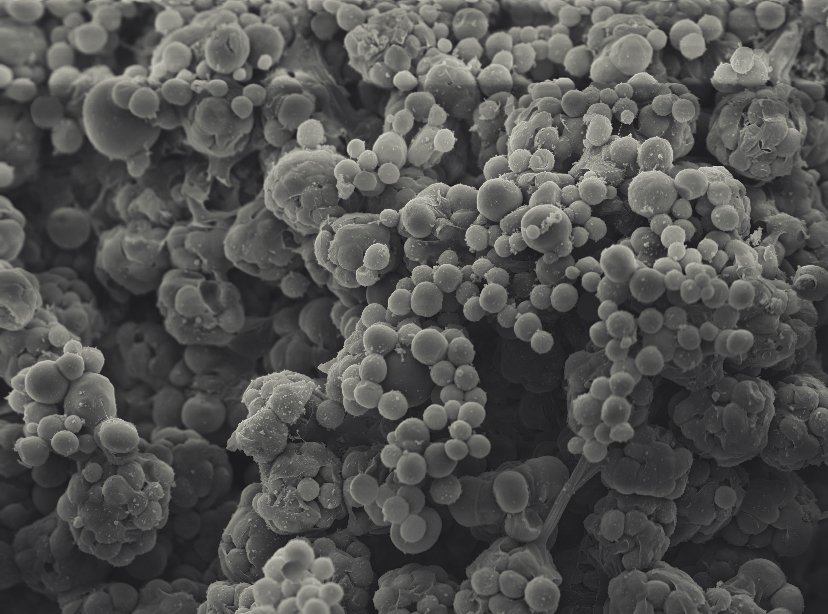
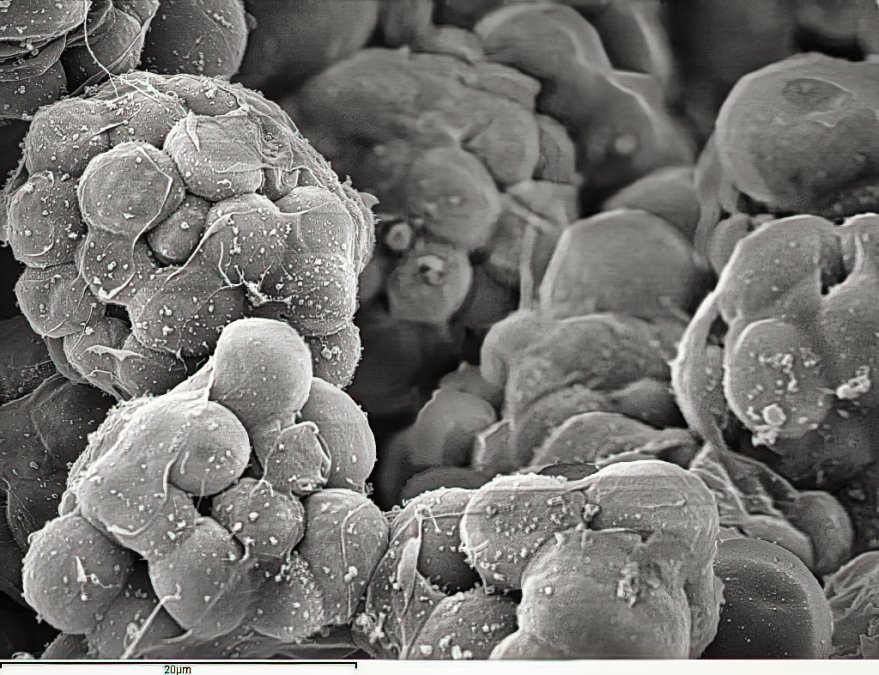
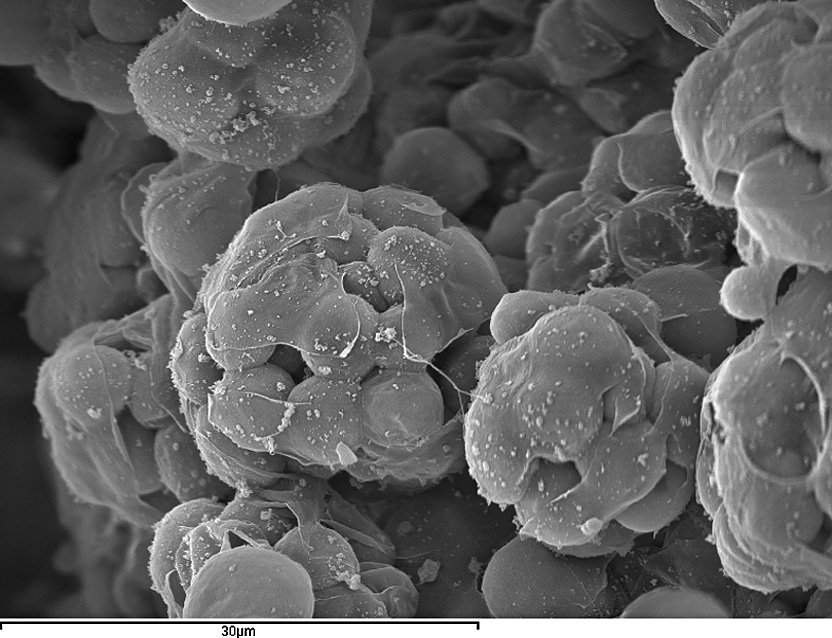
The shared cytoplasm is partitioned around its nuclei, creating many daughter cells at once.
New amoebae leave through openings in the parental wall and begin the cycle again.
WHY IT MATTERS
Creolimax offers a living version of a provocative evolutionary route: multicellularity arising through the cellularization of a multinucleate ancestor. Its synchronized nuclei, temporally distinct cell states and motile amoebae let us examine how developmental programmes could predate animals.
A HISTORIC FIRST
In 2013, Creolimax became the first close unicellular relative of animals in which both cell transformation and gene silencing were established.
This made it possible to label nuclei in living cells, reveal strictly synchronized nuclear divisions and test gene function experimentally.
CELL-TYPE PROGRAMMES
Nuclear divisions occur in a strict rhythm before cellularization begins.
Amoeboid and multinucleate stages activate distinct transcriptional programmes.
Alternative splicing and long non-coding RNAs contribute to a dynamic unicellular life cycle.
Cytoskeletal reorganization accompanies the conversion of one cytoplasm into many cells.
FOUNDATIONAL WORK
Marshall and colleagues repeatedly isolated the organism from marine invertebrates and described its distinctive amoeboid dispersal stage.
↗2013Experimental manipulation revealed synchronized nuclear division and established Creolimax as a model for the cellularization route to multicellularity.
↗2015Taxon-rich phylogenomics clarified the placement of ichthyosporeans within the closest relatives of animals.
↗2015Transcriptomics uncovered stage-specific programmes, alternative splicing and long non-coding RNAs across the life cycle.
↗GENOME & RESOURCES
CONTINUE EXPLORING